SYSTEMS INTEGRATION
Stop working in silos.
Start operating as one.
Silos don’t fail because the tools are bad—they fail because the connective tissue between them was never designed. We architect that tissue: the APIs, data flows, and automations that turn separate systems into a single, coherent operation.
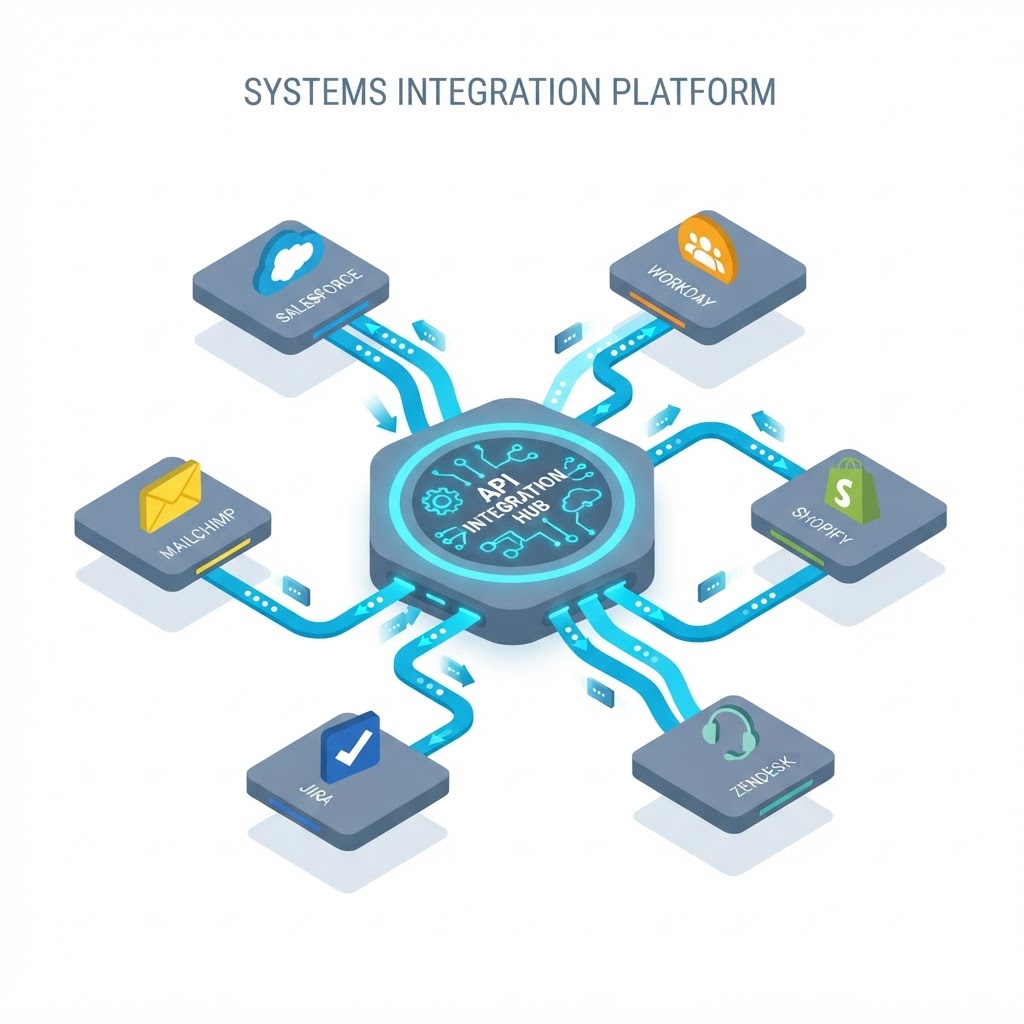
THE COST OF SILOS
What fragmentation actually costs you.
Disconnected systems
Teams export, email, and re-key data between tools that were never built to talk to each other.
Duplicated effort
The same record lives in five places, drifts apart, and erodes trust in every report.
Slow, manual handoffs
Work waits at every team boundary while context is reconstructed from scratch.
THE CONNECTED STATE
From many tools to one system.
API architecture & management
Design and govern the contracts between your systems.
Data orchestration
Move and unify data so every team works from one source of truth.
Workflow automation
Replace manual handoffs with reliable, observable flows.
Legacy connectivity
Bridge older platforms into modern ecosystems without rip-and-replace.
Event & messaging layers
Let systems react in real time instead of polling and reconciling.
Observability & governance
Know what connected, what failed, and what to improve next.
INTEGRATION PATTERNS
The architectures that end the silo.
API-led integration
Structured, documented APIs as the contract between systems—so connections are predictable, versionable, and replaceable.
Event-driven flows
Systems emit and react to events in real time, eliminating polling, batch reconciliation, and stale data.
Data unification
A single source of truth where master data is reconciled, governed, and trusted across every consuming system.
Hybrid & legacy bridges
Connectors and adapters that bring older platforms into modern workflows without a risky rip-and-replace.
OUR PROCESS
From fragmented to connected.
Map
We chart every system, data owner, and handoff to find where value is actually being lost.
Design
We define the integration architecture—APIs, events, and data flows—before any code is written.
Connect
We build and test connections incrementally, with each link observable and reversible.
Govern
We put observability, ownership, and change processes in place so the system stays healthy as it grows.
DESIGN PRINCIPLES
How we keep the system whole as it grows.
One source of truth
Every record has a canonical home; everything else is a view—so decisions are made on facts, not fragments.
Loose coupling
Systems stay independent but coordinated, so a change in one doesn’t cascade into breakage everywhere.
Observable by default
Every flow is traceable—so when something breaks, you know where, why, and how to fix it fast.
Reversible & safe
Connections are built to be changed or removed without taking the operation down with them.
Automated, not manual
Repeatable flows replace human handoffs—removing the errors, delays, and drudgery of re-keyed work.
Built to evolve
The architecture accepts new systems and retiring ones as normal—not as emergencies.
NEXT STEP